
Bitcoin’s Adoption Curve: Why the Price Chart That Really Matters Isn’t the Price Chart
I first understood Bitcoin and how blockchain technology works in early 2017, when Bitcoin was around $1,000. Like most of the world, I wish I had backed up the truck back then as Bitcoin has done more than 100x moves upward.
I’m Joel Comm, and I’ve spent more than 30 years in internet business and entrepreneurship. I spend a lot of time talking about how technology adoption works, and nowhere is this more relevant than in understanding Bitcoin.
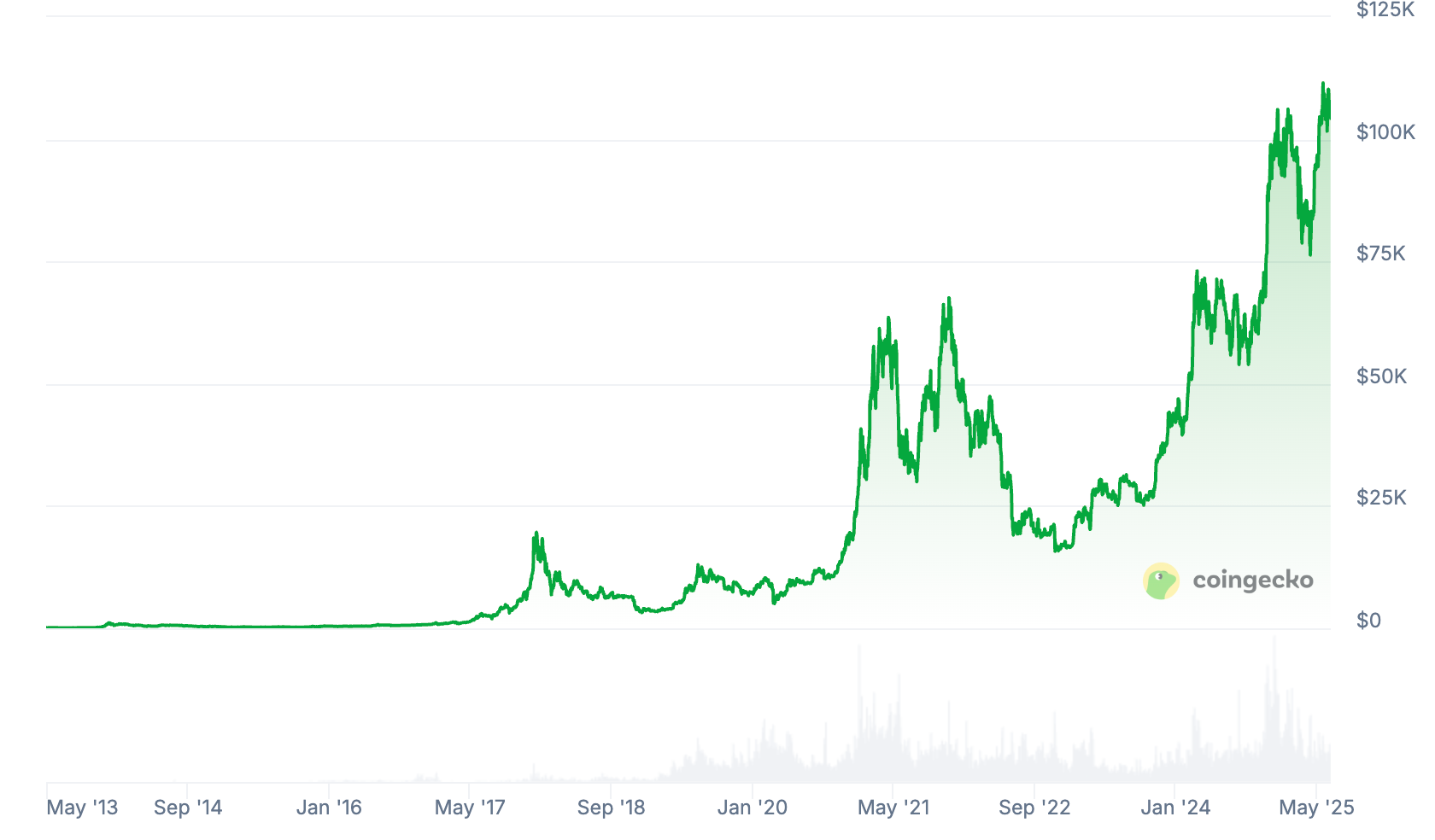
Bitcoin goes up. Bitcoin goes down. This oft-repeated mantra is true to some degree when looking at price charts. After all, volatility is a feature of Bitcoin. When we look at a price chart from 2013 through today, we see a lot of ups and downs. Some massive green candles and some painful drawdowns from profit-taking.
But even with the long-term appreciation in Bitcoin, it’s easy to understand the day-to-day feelings that accompany the price volatility. In December of 2021 we hit an all-time high of $69,000, only to watch Bitcoin drop to $15,000 by fall of the next year. And again late in 2024 we hit $108,000 only to watch the price dip to $75,000 earlier in 2025. Of course we are back over $100,000 now, but you’ve really got to have a strong stomach to invest in an asset with so much volatility.
The Technology Adoption Curve is the Only Chart That Matters
If this is you, perhaps you are looking at the wrong chart. You see, to me there is only one chart that truly matters: the technology adoption curve, and the Bitcoin chart that can be derived from understanding it.
The bell curve showing technology adoption can be applied to all technology. You have the innovators and pioneers which make up less than 2.5% of the population. They are the risk-takers and usually are laughed at by the rest of the world. Next are the early adopters, and they make up around 13% of the population. These people are quite comfortable taking on new ideas. After that is everyone else, beginning with mainstream adoption—the rest of the world.
In 2024, Bitcoin turned the corner to mainstream adoption by offering ETFs, traditional financial instruments backed by traditional finance. Welcome to the party, Bitcoin!
Real Indicators of Adoption Are Emerging
But so much has happened since that time, and it has been on the trajectory to happen all along. Not only do we have ETFs from a number of major financial brokerage and investment firms, but we also have other indicators that nothing can stop the Bitcoin juggernaut:
- El Salvador was the first nation-state to adopt Bitcoin as legal tender. It’s the first of what will be many to follow.
- In contrast to the Biden administration, we have a pro-crypto administration with Trump. Many in Congress are leading the way to sound crypto regulation and legislation that will pave the way for more adoption.
- New Hampshire, Arizona and Texas have already passed a Bitcoin strategic reserve for their states. Others are in the process of following.
- Michael Saylor’s company, Microstrategy, is defying gravity by creating a Bitcoin treasury company that has already acquired nearly 600,000 Bitcoin. That’s 2.8% of the TOTAL supply, not accounting for missing Bitcoin and the over 1,000,000 BTC that has yet to be mined.
- Many other companies are following suit and duplicating Saylor’s model. It’s estimated that close to 1,000,000 BTC are currently held by enterprise which are not selling from their treasury—ever.
- According to Grok, a liberal estimate is that 50 million people in the world own at least .01 BTC. That’s less than 1% of the 5.5 billion global adult population.
The Adoption Curve Chart Never Goes Down
While there are more bullet points I can provide to demonstrate growth in adoption, I really want to share this key insight: look at what the technology adoption curve actually shows you. This chart is not volatile. This chart doesn’t go down. Due to the technology adoption curve, this chart is ONLY UP.
Only up.
What does the future of Bitcoin look like? Are the projections of $1,000,000 or more per coin realistic? You do the math, if you wish. Barring quantum computing breaking the blockchain or a total nuclear war, I don’t see any reason that adoption won’t continue as only up.
Of course, this is all just my opinion and is NOT financial advice. As always, do your own due diligence and be responsible for your own finances.
As for me, when Bitcoin goes up or down $5,000 in a day, I just look at the adoption curve and grin.
Stay tuned for more insights on technology adoption and what’s next in AI and the internet. Subscribe to my newsletter or listen to my podcast, the AI for Everyone Show, to stay ahead of the curve.
