
Is Elon Musk the da Vinci of Our Time?

In May 1999, Barron’s put Jeff Bezos on its cover with his head drawn inside a cartoon bomb, fuse lit. The headline was “Amazon.bomb.” The argument inside was clean and confident. Bezos was initially ridiculed for selling books out of his garage. Then he was derided because the stock was overpriced. People predicted Walmart or Barnes & Noble would walk into online retail and end him.
Over the next two years, it appeared Barron’s had nailed it. Amazon’s stock fell about 95 percent. By 2001 it traded under six dollars.
Then Amazon turned its first profit in the fourth quarter of 2001. You know how the rest went. The magazine wasn’t describing a failure. It was describing one of the most valuable companies of the next twenty-five years, and it got the story in reverse.
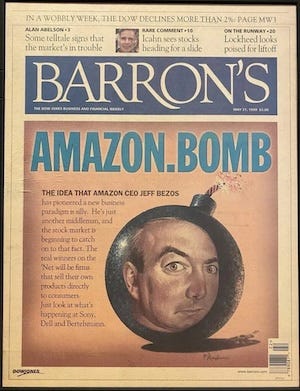
I think about that cover whenever I watch people line up to bury someone who’s still in the middle of building.
Plot twist. The doubt is not the story
There’s a simple way to look at this. If the great ones were all mocked, and you’re being mocked, you must be great. I suppose it could be comforting to tell yourself that when you are sweating it in the middle of the night. Unfortunately, it’s a false conclusion.
For every Bezos who proved the critics wrong, there’s a founder the doubters read correctly. Adam Neumann sold WeWork as a tech company that would remake how the world worked, raised billions on it, and watched the whole story come apart the moment people looked closely. Sam Bankman-Fried was hailed as a generational mind right until the fraud under FTX collapsed and took customer money with it. The skepticism around those two wasn’t short-sighted. It was actually quite accurate. So being laughed at isn’t a credential. Plenty of laughed-at ideas earned it.
The idea that “they were doubted” isn’t the story here. Almost everyone ambitious gets doubted. The thing to pay attention to is what the vindicated ones did with the doubt, and what set them apart from the people who earned their bad reviews.
They delivered.
What the record actually shows
Henry Ford didn’t arrive in his final form. His first company, the Detroit Automobile Company, dissolved in 1901 after building a handful of cars nobody wanted. His second venture fell apart over a fight with his backers, and the company he left behind was reorganized into Cadillac. He walked away with a damaged reputation and roughly nine hundred dollars.
Most people would have read that as failure. Ford read it as data. He’d learned what cost too much, what slowed production, and why he needed control over the engineering. The Model T and the moving assembly line came out of a man everyone had already written off twice.
Steve Jobs got pushed out of his own company in 1985. Apple’s stock went up on the news. Wall Street was relieved. He started NeXT, which the market treated as an expensive disappointment for more than a decade. In 1997, Apple paid 429 million dollars to acquire NeXT, and most people who study that deal agree on what it really bought. It bought Jobs. He came back and delivered the iMac, the iPod, the iPhone, and the iPad. The man Apple celebrated leaving became the reason Apple exists as it does today.
Leonardo da Vinci is the name people reach for when they want to describe a mind with no boundaries, and the Renaissance man label is his for a reason. He painted the Mona Lisa and the Last Supper. He cut open cadavers and mapped muscle and bone with an accuracy medicine wouldn’t match for generations. He drew flying machines, diverted rivers on paper, and designed weapons for whichever noble was paying that year. Painter, anatomist, engineer, weapons designer, town planner, musician, sometimes all of it at the same time.
He also messes with the simple version of this story, which is why he belongs in it. Unlike the others, he wasn’t mocked into obscurity. He was celebrated in his own lifetime. But he carried a reputation as a man who couldn’t finish what he started. The giant bronze horse he labored over for a decade never got cast. The bronze went to make cannons, and French soldiers later used his clay model for target practice. He left fewer than twenty finished paintings. By some accounts he died believing he had failed.
History books kept him anyway. Not because the critics came around, but because of what he did finish, and because his notebooks turned out to be centuries ahead of the times. The lesson there is harsh. The crowd’s opinion in the moment, good or bad, is not the thing that lasts. The work is.
We’ve seen the same pattern repeat multiple times this century. Brian Chesky pitched strangers sleeping in your spare room, got turned down by most investors who heard it, and kept Airbnb breathing for a stretch by selling novelty cereal boxes. Jensen Huang spent years pouring Nvidia’s money into chip software most analysts filed under niche distraction, until the AI wave turned that gamble into one of the most valuable companies on the planet. Neither looked obvious at the time. Both look inevitable now, which is the trick memory plays on every story like this.
Where Musk actually fits
Elon Musk is the live version of this argument, which is why it’s so hard to discuss him without the conversation turning into an argument.
Let’s begin with the part that’s settled. In 2008, SpaceX failed its first three Falcon 1 launches. Musk had poured most of his PayPal money into the company and was nearly depleted. The fourth launch, on September 28, 2008, succeeded on what he later called the last money they had. Months later NASA awarded a 1.6-billion-dollar resupply contract. That same Christmas, Tesla was days from running out of cash, sitting on about nine million dollars in the bank.
The people who didn’t have Musk’s vision had a clear read on all of this. A private company couldn’t run a space program. An electric car company couldn’t survive Detroit. Both reads were reasonable. But both were wrong. SpaceX now lands and reuses orbital rockets at a scale no competitor has matched, flew NASA astronauts from American soil in 2020, and just pulled off the largest IPO in history. That’s not hype. It’s a measured engineering result that changed the economics of getting to orbit.
This is where the da Vinci comparison stops being a compliment and turns literal. Range is the whole point of the man. Musk runs a rocket company, a car and energy company, an AI lab, a satellite internet network, a brain-implant startup, a tunneling company, and a social platform, often pushing all of them at once. Nobody else alive is working that many frontiers in parallel. Strip away how you feel about him and the structure is the same one da Vinci had. A single mind refusing to stay in a single field. The comparison stands just based on the range of what he is attempting to accomplish, and it isn’t close.
Now to be impartial let’s examine the part that isn’t settled.
Musk has a long, documented habit of missing his own deadlines, and the breadth is part of the reason. A person working that many fronts at once leaves a trail of half-kept promises, which might be the most da Vinci thing about him. Full self-driving was promised by 2018. A million robotaxis on the road by 2020. Humans on Mars by 2024. None of those arrived on schedule, and some courts and customers have treated this canyon between what was promised and what delivered as a significant problem. Add the political turn of the last two years, which cost Tesla real sales and alienated part of its own customer base, and you get a figure who’s contested, not simply misunderstood.
So which is he? Today’s da Vinci, or an overhyped man selling timelines he can’t keep?
I’d argue there is short-sighted thinking on both sides of this particular question.
History keeps the work, not the man
The record from Ford to Bezos points one direction. History remembers what got built. It’s far less sentimental about the builder than the fans or the critics are while the thing is happening.
Ford put the world on wheels and also spent his later years publishing material so ugly it stains his name to this day. If you aren’t familiar with what he wrote, it could be the subject of an entirely different piece. Suffice to say that Ford did a great thing and a pretty horrible thing. History recorded the assembly line and footnoted the rest. The point is that his work outlived the man’s worst self.
Apply that lens to Musk and the things become a little clearer. Reusable rockets and the mainstreaming of the electric car are the kind of thing that lands in textbooks regardless of how anyone feels about his posts on his own social platform. The broken self-driving timelines and the political fights are far more likely to end up as footnotes, just like Ford’s. People who dismiss the achievements because they can’t stand the man are making the Barron’s mistake in reverse. They’re letting a feeling about the cover stand in for the contents.
And the people who treat every Musk promise as already delivered are making the opposite error. Doubt isn’t proof of genius, and neither is loyalty.
The honest position is less satisfying than either tribe wants. The man is contested. Some of the work is already historic. Some of the promises are still IOUs. All of that can be true at once, and pretending otherwise is how smart people end up writing the next cover they’ll have to apologize for.
The real skill isn’t picking a side early. It’s holding off on the eulogy or the coronation long enough to see what actually gets shipped. The crowd almost never can. That’s the takeaway we can own long after the public shifts to a new argument.
Disclosure: As I’ve held true to this thesis for several years, I’m an investor in SpaceX and xAI.


